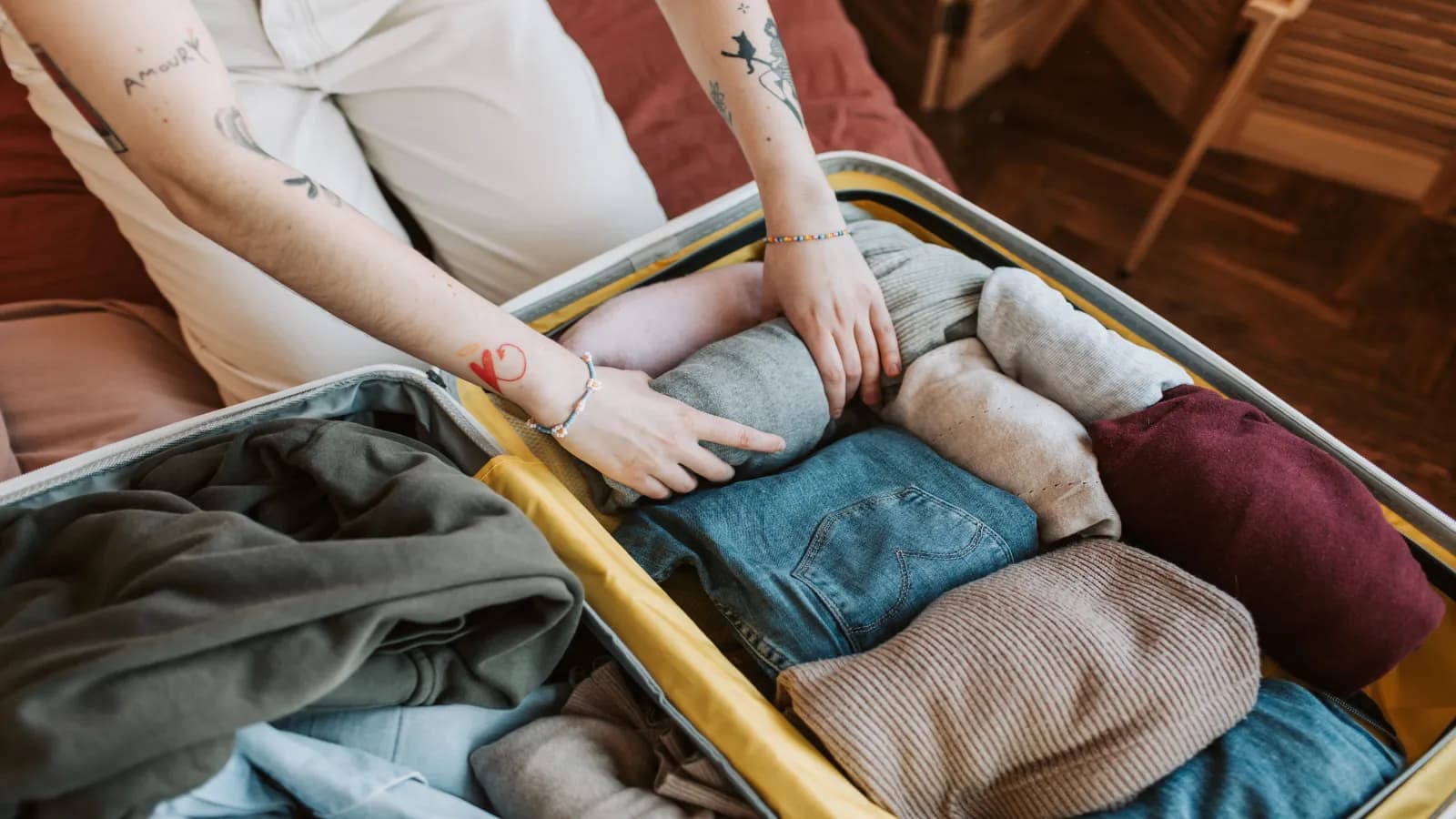
Most overpacked suitcases are not full because the traveler needs too many clothes.
They are full because the clothes were selected one item at a time.
A shirt is packed because it might be useful. Then another pair of trousers is added for a possible dinner. A third pair of shoes enters the suitcase because the weather could change. By the time the bag is closed, it contains plenty of clothing but very few complete outfits.
The 5-4-3-2-1 packing formula approaches the problem differently.
Instead of asking, “What might I wear?”, it asks:
“How many compatible combinations can I create from a limited number of pieces?”
There are several versions of the formula online. It is not an airline rule or an official baggage standard. For practical carry-on travel, the Fintayo version is:
- 5 tops
- 4 bottoms
- 3 layers or special-purpose pieces
- 2 pairs of shoes
- 1 travel outfit
The objective is not to obey the numbers at any cost. It is to create a coordinated wardrobe in which almost everything works with almost everything else.
Why the formula can work for a seven-day trip
Five tops combined with four bottoms create up to 20 basic pairings.
You will not necessarily wear all 20. Some pieces may be intended for different weather, activities or levels of formality. But even if only half of the combinations work well, the wardrobe can still cover a week without feeling repetitive.
The formula works because it limits three common causes of overpacking:
- duplicate clothes performing the same job
- pieces that match only one outfit
- bulky “just in case” items
It is best suited to a five-to-ten-day city break, holiday or mixed leisure trip where clothes can be reworn or washed if necessary.
It is less suitable for journeys requiring specialist equipment, several formal events or dramatically different climates.
Check the baggage allowance before choosing the clothes
“Carry-on only” does not mean the same thing on every airline.
IATA advises passengers that luggage dimensions and weight allowances can vary by airline, cabin class and even aircraft type. The allowance attached to the actual reservation should therefore be checked before packing begins.
Current airline rules illustrate how different two seemingly similar tickets can be:
| Airline example | Small bag included | Larger cabin bag |
|---|---|---|
| Ryanair | Maximum 40 × 30 × 20 cm | A 10 kg bag up to 55 × 40 × 20 cm is included with eligible Priority products |
| easyJet | Maximum 45 × 36 × 20 cm, up to 15 kg | Maximum 56 × 45 × 25 cm with an eligible fare, seat or separate purchase |
Ryanair’s current rules require the free personal bag to fit under the seat, while its larger cabin allowance depends on the purchased product. EasyJet currently allows one small under-seat bag for every passenger, while access to a larger overhead bag depends on the booking.
That difference determines which version of the formula is realistic.
A wardrobe that fits easily inside an overhead suitcase may not fit into a free under-seat backpack.
5 tops: build the wardrobe around repeatable pieces
The five tops should not be five variations of the same item. Each one should perform a clear role.
For a moderate or warm-weather trip, a practical selection could be:
- Two everyday T-shirts or casual tops
- One smarter shirt, blouse or polo
- One lightweight long-sleeved top
- One active, breathable or quick-drying top
At least four should work with every bottom.
That compatibility is more important than the individual style of any one garment.
A simple colour structure helps:
Two neutral base colours One secondary colour One limited accent colourFor example:
Black + beige + blue + one green accentThis prevents the classic packing mistake of bringing a striking top that works with only one pair of trousers and requires its own shoes.
The fastest compatibility test is to place all five tops on the bed and ask whether each one works with at least three of the four bottoms.
If it does not, it needs a strong reason to remain in the suitcase.
4 bottoms: choose different functions, not minor variations
Four bottoms are sufficient only when they do different jobs.
A seven-day warm-weather selection might include:
- one pair of comfortable everyday trousers
- one pair of shorts
- one smarter pair of trousers or a skirt
- one lightweight or active bottom
Packing three similar pairs of jeans defeats the purpose. Denim is relatively bulky, takes longer to dry and creates fewer genuinely different outfits than the number of items suggests.
Before packing each bottom, ask:
- Can it be worn for several hours comfortably?
- Can it be worn with at least four tops?
- Can it be dressed up or down?
- Will it dry overnight if washed?
- Does another packed item already perform the same function?
The most useful bottom is rarely the most fashionable item in isolation.
It is the one that creates the largest number of usable combinations.
3 layers or special-purpose pieces
This is where many versions of the 5-4-3-2-1 formula become impractical.
Some suggest three dresses, three accessories or three pairs of shoes. For carry-on travel, the Fintayo version uses the number three for pieces that adapt the wardrobe to changing conditions.
A balanced selection could be:
- One light jacket or weather-resistant outer layer
- One cardigan, overshirt or lightweight knit
- One destination-specific piece
The third item depends on the journey:
- swimsuit for a coastal destination
- compact rain shell for unstable weather
- dress or blazer for a formal dinner
- sports outfit for an active trip
- thermal layer for a colder climate
This slot prevents special-purpose items from quietly multiplying.
Instead of packing a separate outfit for every possible activity, one deliberate wildcard is selected.
2 pairs of shoes means two in total
Shoes are usually the fastest way to lose carry-on space.
The formula should mean:
- one pair worn during travel
- one pair packed
For a city trip, this could be:
Comfortable walking shoes + lightweight smarter shoesFor a summer destination:
Comfortable trainers + sandalsFor an active journey:
Walking shoes + compact casual shoesBoth pairs should work with most of the wardrobe.
Three pairs may be justified for a specialist trip, but adding a third pair should require removing something else rather than simply forcing it into the bag.
Wear the heaviest and bulkiest pair during the flight. Pack the lighter pair sole-to-sole in a shoe bag, shower cap or washable pouch.
Do not fill shoes with delicate items that could be damaged, but socks, charging cables or other protected small objects can use the empty space.
1 travel outfit
The travel outfit is part of the wardrobe, not an extra set of clothes.
It should usually contain the bulkiest wearable items:
- heavier shoes
- long trousers
- T-shirt or base layer
- cardigan or overshirt
- jacket
This reduces suitcase volume without requiring uncomfortable airport clothing.
The outfit should also remain practical if the checked-gate process, weather or transport plans change.
Avoid treating travel day as an opportunity to wear every heavy item at once. A thick coat, two sweaters and heavy boots may technically save baggage space but can make a long airport journey unnecessarily uncomfortable.
The correct travel outfit is the heaviest reasonable combination.
A complete seven-day Fintayo packing example
For a spring or mild-summer city trip, the wardrobe could look like this:
Five tops
2 neutral T-shirts 1 smarter shirt 1 lightweight long-sleeved top 1 active or quick-drying topFour bottoms
1 comfortable travel trouser 1 lightweight trouser 1 pair of shorts 1 smarter bottomThree layers or special pieces
1 light jacket 1 cardigan or overshirt 1 swimsuit, rain shell or dressier pieceTwo pairs of shoes
1 walking pair worn during travel 1 lighter pair packedOne travel outfit
T-shirt + comfortable trousers + overshirt + jacket + walking shoesThis gives the traveler enough variation for sightseeing, transport, casual dinners and one more polished occasion without creating an entirely separate wardrobe for each activity.
What the formula does not count
The 5-4-3-2-1 numbers apply to the main wardrobe.
They do not normally include:
- underwear
- socks
- sleepwear
- toiletries
- medication
- electronics
- chargers
- travel documents
- accessories
But “not counted” must not become “unlimited.”
A sensible supporting list for seven days could be:
7 pairs of underwear 4–7 pairs of socks, depending on footwear 1 set of sleepwear 1 belt 1 compact scarf 1 small accessory setUnderwear and socks are small, but bringing far more than the trip requires still consumes space and makes the packing system less disciplined.
Toiletries can ruin an otherwise perfect carry-on
Clothing is only part of cabin baggage.
Under current EU airport-security rules, liquids carried through screening generally need to be in individual containers of no more than 100 ml and placed in a transparent, resealable bag, subject to the stated exemptions.
Liquids can include more than drinks:
- toothpaste
- creams
- gels
- liquid cosmetics
- sprays
- sunscreen
- perfume
Do not fill a 100 ml bottle for a four-day journey if 20 ml is sufficient.
Solid alternatives can reduce both volume and security-screening complexity:
- solid deodorant
- shampoo bar
- soap bar
- toothpaste tablets where suitable
- solid cosmetics
Medication and essential medical products should be handled according to the relevant airport and airline instructions rather than forced into a generic packing formula.
The cold-weather version
The formula still works in colder conditions, but the role of each number changes.
Five tops
Use thinner layers rather than five thick sweaters:
2 base layers 2 normal tops 1 smarter or warmer topFour bottoms
2 everyday trousers 1 thermal or active bottom 1 smarter bottomThree layers
1 knit 1 fleece or insulating layer 1 outer jacketTwo shoes
1 weather-resistant pair 1 lighter indoor or casual pairOne travel outfit
Wear the heaviest coat, shoes and trousers.
The main principle is to layer thin garments rather than pack several bulky standalone outfits.
Packing cubes do not solve a bad wardrobe
Packing cubes can improve organisation and compress soft clothing slightly, but they do not reduce the weight of the bag.
They also cannot fix five tops that do not match the four bottoms.
Choose the wardrobe first. Use cubes afterward.
A useful three-cube system is:
Cube 1: tops Cube 2: bottoms and layers Cube 3: underwear, socks and sleepwearThe bag should still close comfortably. A suitcase that requires force to close is more difficult to repack during the trip and leaves no room for small purchases.
The final 10-minute carry-on test
Before departure:
- Check the baggage rules shown on the booking.
- Measure the bag including handles and wheels.
- Weigh it with toiletries and electronics inside.
- Put on the complete travel outfit.
- Confirm that every top works with at least three bottoms.
- Remove any item that duplicates another item’s function.
- Check the weather forecast again.
- Confirm that medicines, batteries and restricted items are packed correctly.
- Lift the bag into the air as if placing it into an overhead locker.
- Leave a small amount of empty space.
The final step matters.
A perfectly packed bag should not be filled to 100% capacity before the journey begins.
The Fintayo takeaway
The 5-4-3-2-1 packing formula is not about surviving a week with the smallest possible number of possessions.
It is about replacing random clothing choices with a coordinated system:
Five tops create variety. Four bottoms create combinations. Three layers adapt to the destination. Two shoes protect the space. One travel outfit carries the bulk.
The formula succeeds when the suitcase contains fewer items but more complete outfits.
The real travel trick is not learning how to force more clothes into the bag.
It is learning which clothes never needed to enter it.
Important: Cabin-baggage dimensions, weight limits, security rules and restricted-item policies vary by airline, airport, route and fare. Confirm the current conditions attached to your reservation before traveling.