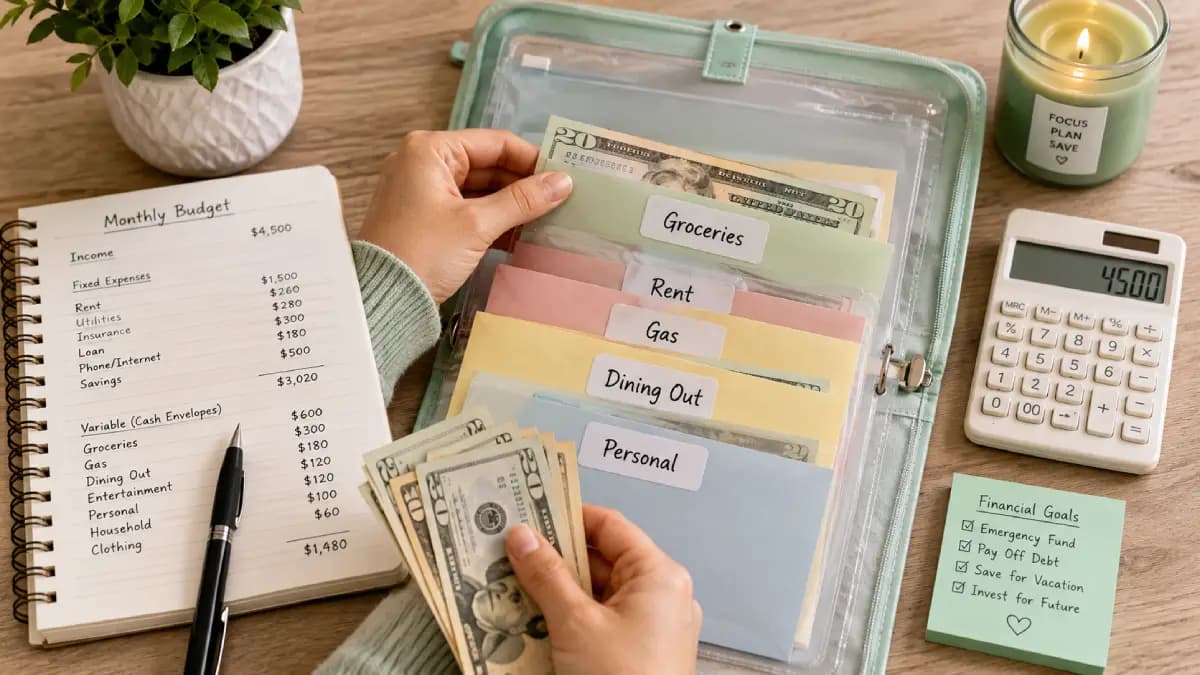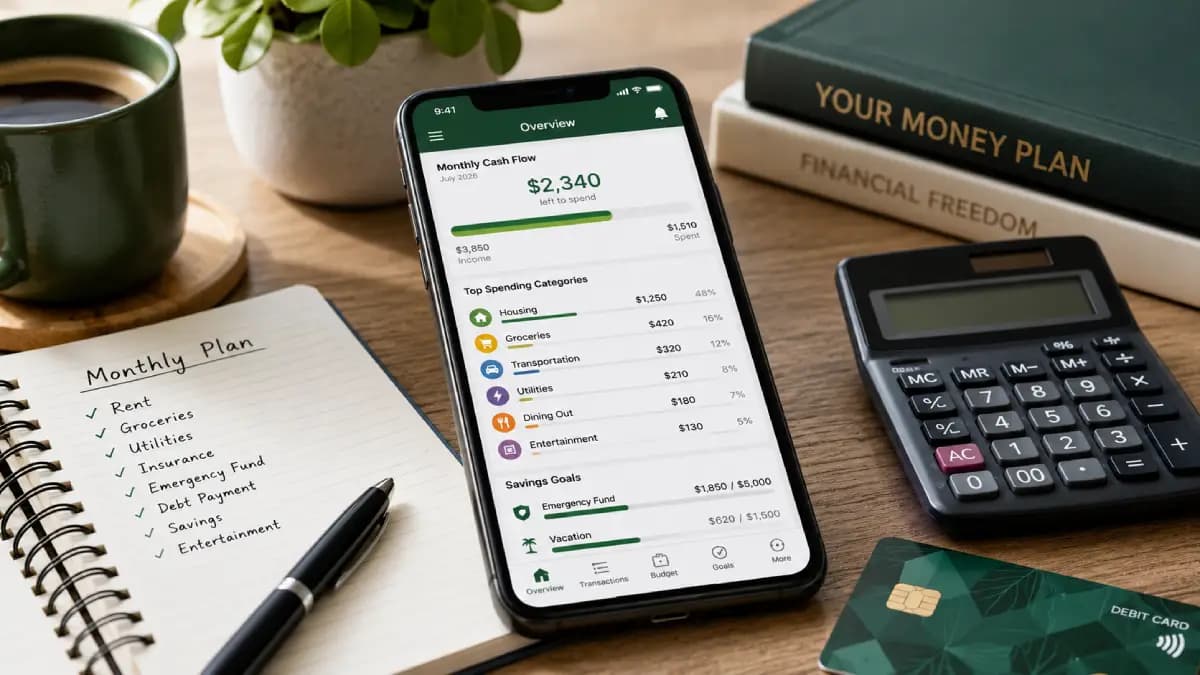
Envelope budgeting is a hands-on money management method that divides your available spending money into separate categories, or “envelopes.” Each envelope has a specific purpose, such as groceries, transportation, entertainment or personal spending.
The traditional version uses physical cash and paper envelopes. Modern versions can use bank subaccounts, prepaid cards, spreadsheets or digital envelope budgeting apps.
The basic rule is simple: once the money in an envelope is gone, spending in that category stops until the next budgeting period.
Key takeaways
- Envelope budgeting assigns a fixed amount of money to individual spending categories.
- The method works best for flexible expenses such as groceries, dining out and entertainment.
- You can use physical cash or digital “envelopes” in an app or bank account.
- When one envelope is empty, you either stop spending or deliberately move money from another category.
- The system can reduce overspending, but it requires regular tracking and realistic category limits.
What is envelope budgeting?
Envelope budgeting is a category-based spending system. At the start of a budgeting period, you decide how much money each category can receive.
For example, a monthly plan may include:
| Envelope | Monthly amount |
|---|---|
| Groceries | $500 |
| Gas and transportation | $250 |
| Dining out | $150 |
| Entertainment | $100 |
| Personal spending | $100 |
| Household supplies | $100 |
If the grocery envelope contains $500, that is the total amount available for groceries during the month.
When the balance reaches zero, you have three options:
- Stop spending in that category
- Wait until the next budgeting period
- Move money from another envelope and accept the tradeoff
The method makes spending limits visible. Instead of checking only whether there is money in your bank account, you check whether money is still available for that specific purpose.
How does the cash envelope system work?
The traditional cash envelope system follows a straightforward process.
1. Calculate your available income
Start with monthly take-home income, not gross income. Include only money that is reasonably expected to arrive during the budgeting period.
If income varies, use a conservative estimate. Our guide on budgeting on a low income explains how to plan when financial margins are limited.
2. Pay fixed bills first
Envelope budgeting is usually most useful for flexible expenses. Fixed bills such as rent, insurance, loan payments and internet service can remain in your bank account and be paid electronically.
Before filling spending envelopes, reserve money for:
- Housing
- Utilities
- Insurance
- Minimum debt payments
- Subscriptions you intend to keep
- Savings contributions
3. Choose your envelope categories
Select categories where spending tends to vary or where you often exceed your intended limit.
Common envelope categories include:
- Groceries
- Dining out
- Gas
- Entertainment
- Clothing
- Personal spending
- Household supplies
- Children’s activities
- Gifts
Do not create too many envelopes at the beginning. Five to eight categories are usually easier to maintain than 20 highly specific categories.
4. Set a spending limit for each envelope
Use recent spending history to create realistic limits.
If you usually spend $650 on groceries, setting the first grocery envelope at $350 is unlikely to work. A more practical starting point may be $575 or $600, followed by gradual adjustments.
The Fintayo Budget Calculator can help you compare income, needs, wants and financial goals before setting category limits.
5. Fill the envelopes
Withdraw the total amount of cash needed for the selected categories and place the money into labeled envelopes.
For example:
- $500 in Groceries
- $250 in Transportation
- $150 in Dining Out
- $100 in Entertainment
- $100 in Personal Spending
You do not need to use cash for every category. Fixed bills and online purchases can still be handled digitally.
6. Spend only from the correct envelope
When buying groceries, use money from the grocery envelope. When paying for a movie, use the entertainment envelope.
This separation prevents one category from quietly consuming money intended for another purpose.
7. Track what remains
The cash balance provides a visual spending signal. If only $60 remains in the grocery envelope halfway through the month, you know that spending must slow down.
You can also record each transaction in a notebook, spreadsheet or budgeting app.
8. Review the envelopes at the end of the month
Compare planned spending with actual spending and ask:
- Which envelopes were empty too early?
- Which categories had money left?
- Were the limits realistic?
- Did you move money between envelopes?
- Which spending decisions caused problems?
Use the answers to adjust the next month’s plan.
Envelope budgeting example
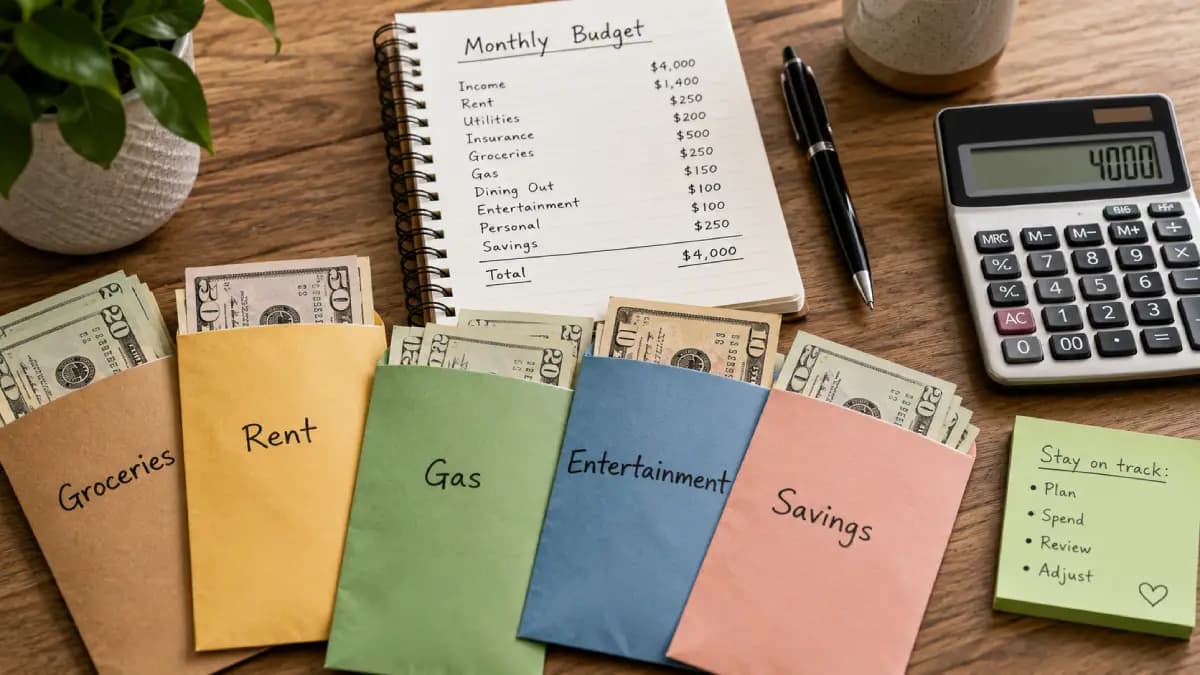
Assume monthly take-home income is $4,000.
Fixed expenses and financial goals total $2,700:
| Fixed category | Amount |
|---|---|
| Rent | $1,400 |
| Utilities | $250 |
| Insurance | $250 |
| Minimum debt payments | $250 |
| Savings | $350 |
| Phone and internet | $200 |
| Total fixed expenses and goals | $2,700 |
This leaves $1,300 for flexible spending.
| Envelope | Amount |
|---|---|
| Groceries | $550 |
| Transportation | $300 |
| Dining out | $150 |
| Entertainment | $100 |
| Personal spending | $100 |
| Household supplies | $100 |
| Total envelope spending | $1,300 |
Every dollar has a defined purpose. This makes envelope budgeting closely related to zero-based budgeting.
What happens when an envelope is empty?
An empty envelope is not automatically a crisis. It is information.
You can respond in one of three ways.
Stop spending
This is the strictest version of the system. If the dining-out envelope is empty, no more restaurant spending occurs until the next month.
Move money from another envelope
You may decide that groceries are more important than entertainment and transfer $40 from one envelope to another.
The transfer should be deliberate. The method loses value if you repeatedly move money without acknowledging what is being sacrificed.
Adjust next month’s limit
If an envelope is consistently too small, the original estimate may be unrealistic.
Increase the category and reduce another category, or look for ways to lower the underlying expense.
Important
Moving money between envelopes is not failure. It becomes a problem only when transfers are automatic, frequent and disconnected from your priorities.
Which expenses work best with envelopes?
Envelope budgeting works best for categories that are flexible and frequently overspent.
Good candidates include:
- Groceries
- Dining out
- Entertainment
- Clothing
- Personal spending
- Beauty and self-care
- Household supplies
- Children’s activities
These expenses benefit from a clear upper limit and immediate feedback.
Which expenses are less suitable for cash envelopes?
Some categories are easier to manage electronically:
- Rent or mortgage
- Utilities paid by automatic withdrawal
- Insurance premiums
- Online subscriptions
- Loan payments
- Retirement contributions
- Emergency savings
You can still treat them as budget categories, but physical cash is usually unnecessary.
Digital envelope budgeting
You do not have to carry cash to use the envelope method.
Digital alternatives include:
- Budgeting apps with category balances
- Bank accounts with virtual subaccounts
- Separate checking accounts
- Prepaid cards for specific spending categories
- Spreadsheets that track remaining category balances
Apps such as Goodbudget are specifically designed around digital envelope budgeting. Other apps allow users to create custom categories that function in a similar way.
Our comparison of the best budgeting apps explains which tools may fit different budgeting styles.
Cash envelopes vs. digital envelopes
| Feature | Cash envelopes | Digital envelopes |
|---|---|---|
| Visibility | Highly visual and tangible | Depends on the app or account |
| Convenience | Less convenient for online purchases | Works well for electronic spending |
| Tracking | Often manual | May be automatic |
| Overspending control | Strong physical limit | Requires checking category balances |
| Security | Cash can be lost or stolen | Protected by account security features |
| Shared household use | Requires coordinating physical cash | Some apps support shared access |
A hybrid system can combine the strengths of both methods. You might use cash for dining and personal spending while managing groceries and transportation digitally.
Advantages of envelope budgeting
It creates clear spending limits
Each category has a visible amount. This makes it harder to confuse the total bank balance with money that is actually available to spend.
It can reduce impulse purchases
Cash creates friction. Handing over physical money may feel more deliberate than tapping a card.
It provides immediate feedback
You can see when a category is running low before the end of the month.
It supports intentional tradeoffs
Moving money between envelopes forces you to decide which priority matters more.
It can simplify flexible spending
Instead of tracking every small purchase against the full household budget, you only need to monitor the remaining envelope balance.
Disadvantages of envelope budgeting
Cash can be inconvenient
Many purchases are made online, through apps or with cards. A cash-only system may not fit modern spending habits.
Cash can be lost or stolen
Money in a physical envelope usually does not have the same protections as funds in a bank account.
It requires preparation
You must choose categories, establish limits, withdraw cash and maintain the envelopes.
It can become too rigid
Unexpected needs may require transfers between envelopes. A system that treats every adjustment as failure can become discouraging.
It does not solve an income shortfall
Envelope budgeting controls allocation, but it cannot make insufficient income cover expenses that exceed it.
Envelope budgeting vs. zero-based budgeting
The two methods are closely related but not identical.
Zero-based budgeting gives every dollar of income a purpose, including fixed bills, savings, debt payments and flexible spending.
Envelope budgeting focuses on separating money into category-specific limits, particularly for spending categories.
You can use both systems together:
- Create a zero-based monthly plan.
- Assign money to all bills, savings and goals.
- Place flexible spending amounts into envelopes.
This combination creates both a complete financial plan and practical day-to-day spending limits.
Envelope budgeting vs. the 50/30/20 rule
The 50/30/20 rule divides take-home income into broad groups:
- 50% for needs
- 30% for wants
- 20% for savings and additional debt payments
Envelope budgeting creates more detailed category limits.
For example, the 30% “wants” category could be divided into separate envelopes for dining, entertainment, shopping and personal spending.
The 50/30/20 rule helps establish broad allocation targets. Envelope budgeting helps control spending inside those targets.
How to start envelope budgeting without using cash
- List monthly take-home income.
- Subtract fixed bills, savings and required debt payments.
- Select five to eight flexible categories.
- Set a monthly limit for each category.
- Create a separate digital balance for every category.
- Update the balance after each purchase.
- Review remaining amounts once or twice per week.
The Fintayo Monthly Budget Planner can help you compare planned spending with actual spending during the month.
Common envelope budgeting mistakes
Creating too many envelopes
Do not create separate envelopes for every possible purchase. Too many categories make the system difficult to maintain.
Setting unrealistic limits
A category should be challenging enough to improve spending but realistic enough to follow.
Ignoring irregular expenses
Annual fees, holidays and car repairs should be handled through sinking funds or separate savings categories.
Borrowing repeatedly from other envelopes
Occasional transfers are normal. Constant transfers suggest that category limits or priorities need revision.
Using envelopes without a complete budget
Envelope budgeting should be part of a broader spending plan that includes fixed bills, savings and debt payments.
Who should consider envelope budgeting?
The method may work well for people who:
- Frequently overspend discretionary categories
- Want a visual and tangible spending system
- Prefer clear category limits
- Are new to budgeting
- Want to reduce credit card use
- Share spending decisions with a partner
Who may prefer another method?
Another method may be better if you:
- Make almost all purchases online
- Prefer automatic transaction tracking
- Travel frequently and do not want to carry cash
- Need detailed investment or net-worth tracking
- Already control spending effectively with a simpler budget
Bottom line
Envelope budgeting creates specific spending limits by separating money into categories. The traditional version uses cash, but the same principles can be applied through apps, bank subaccounts or spreadsheets.
The method is especially useful for variable expenses such as groceries, dining out, entertainment and personal spending.
Start with a small number of categories, set realistic limits and review the results at the end of the month. If physical cash feels inconvenient, use digital envelopes or a hybrid approach.
The goal is not to follow the method perfectly. The goal is to make spending decisions visible before the money is gone.
Frequently asked questions
Does envelope budgeting require cash?
No. You can use budgeting apps, bank subaccounts, spreadsheets or separate card balances to create digital envelopes.
What should I do with money left in an envelope?
You can roll it into the next month, move it to savings, add it to a sinking fund or apply it toward debt. Decide on a rule before the month ends.
How many budget envelopes should I have?
Beginners may find five to eight flexible spending categories manageable. Add more only when the extra detail improves decisions.
Is envelope budgeting the same as cash stuffing?
Cash stuffing is a modern name for physically placing cash into labeled categories. It is one form of envelope budgeting.
Can envelope budgeting help pay off debt?
It can help control flexible spending and free money for additional debt payments. Required payments and extra debt contributions should remain part of the overall monthly budget.
What happens if I spend more than an envelope contains?
You must stop spending, move money from another envelope or revise the category limit. The important step is to make the tradeoff consciously.